The audio task
A musician posting a track alongside AI-generated visuals, or an AI-generated audio clip alongside real footage, needs to know whether Meta requires a label and how that label is applied. Meta's own announcements distinguish what it can detect automatically from what it asks users to disclose.
What the documents show
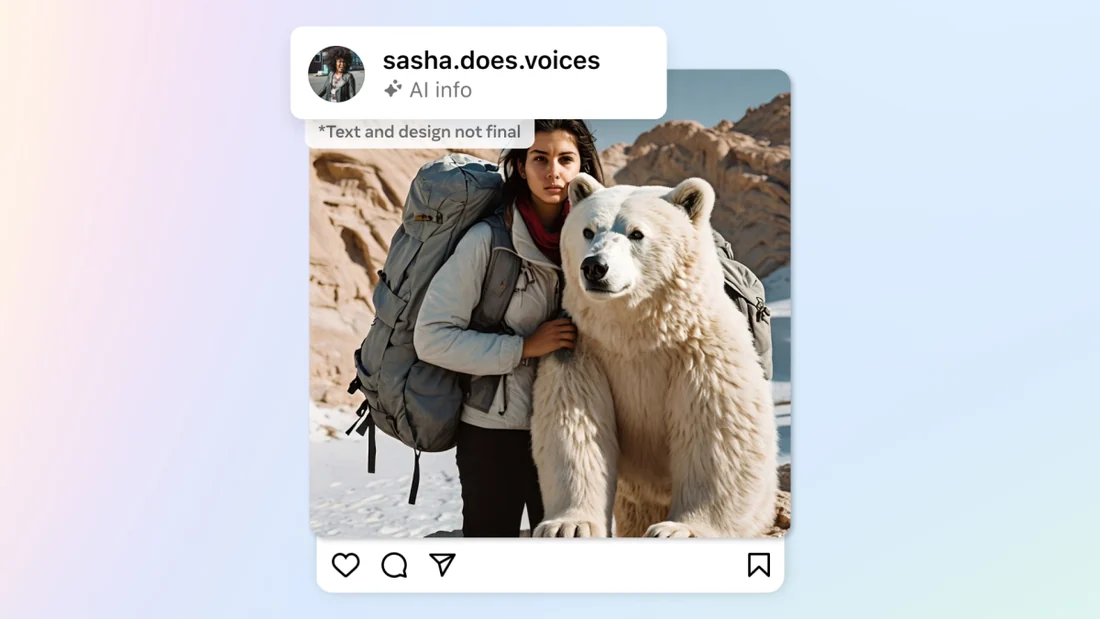
Meta's 6 February 2024 newsroom post states Meta applies “'Imagined with AI' labels to photorealistic images created using our Meta AI feature” and was working with industry partners on “common technical standards,” such as “IPTC metadata and invisible watermarks,” to detect AI images from other companies' tools. For video and audio, it states a different mechanism: since the industry “haven't started including them in AI tools that generate audio and video at the same scale, we can't yet detect those signals,” so Meta was “adding a feature for people to disclose when they share AI-generated video or audio.” A follow-up post, “Our Approach to Labeling AI-Generated Content and Manipulated Media”, originally published 5 April 2024, records that the “Made with AI” label was renamed “AI info” starting in a 1 July 2024 update after Meta found the original wording “weren't always aligned with people's expectations,” and that a further 12 September 2024 change moved the label to a post's menu for content only edited, rather than generated, by AI.
Rights status
These posts describe a transparency and integrity labeling system, not a copyright or licensing framework. The February 2024 post states Meta “will require people to use this disclosure and label tool when they post organic content with a photorealistic video or realistic-sounding audio that was digitally created or altered, and we may apply penalties if they fail to do so,” but it does not define those penalties in specific terms, and neither post addresses who owns rights to an AI-generated track or voice used in a post.
What to check before you use it
This is an editorial checklist. Before posting music paired with AI-generated audio or video: use Meta's self-disclosure tool for any realistic-sounding audio rather than relying on automatic detection, since the posts state detection for audio and video is not yet available at image scale; distinguish a Meta AI-made image, which may be auto-labeled, from a track made with another company's tool, which still depends on the cross-industry standards described; and expect the label's name and placement to keep changing, since it was renamed and relocated twice within a year of the original announcement.
- Is the audio or video in this post realistic enough that Meta's disclosure requirement, rather than its detection system, applies?
- Has the current self-disclosure tool actually been used for this specific post?
- Does the label name and placement in effect today match “AI info” as described in the 2024 updates, or has it changed again?
Meta frames its own labeling system as a work in progress tied to detection capability, so its coverage of audio specifically is likely to keep expanding as the cross-industry technical standards it describes mature.
Sources & reading trail
States the original 'Made with AI' image detection approach and the self-disclosure requirement for realistic audio and video.
Source published: 6 February 2024 · Retrieved: 16 September 2026
Records the July and September 2024 revisions renaming and relocating the AI content label.
Source published: 5 April 2024 · Retrieved: 16 September 2026
Documentation, licences and platform policies establish the note; the what-to-check reading is Music Tech Field Notes editorial analysis. This retrospective draft does not imply the site published on the event date.