The audio task
A songwriter stuck translating an image, a lyric idea, or a reference recording into a chord progression is doing a specific, narrow job: turning inspiration in one medium into playable harmony, without losing the sense that the choices are still theirs.
What the documents show
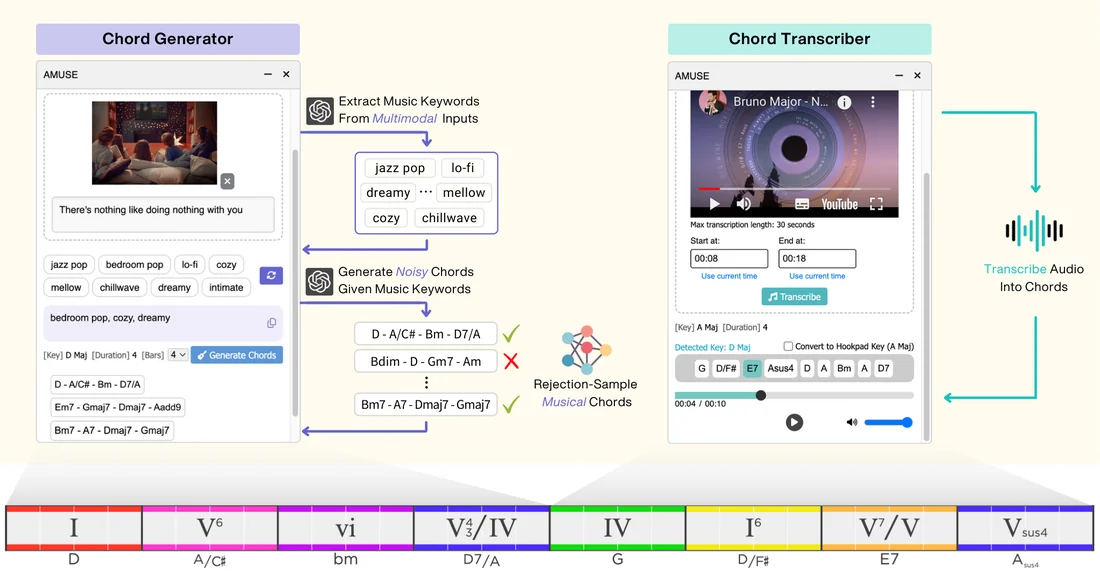
A paper first posted to arXiv on 25 December 2024, and later published as a CHI 2025 conference paper, describes Amuse, a tool that turns an image, text, or audio prompt into chord-progression suggestions by pairing a multimodal large language model with a filtering chord model. The authors, Yewon Kim, Sung-Ju Lee, and Chris Donahue, tested it with ten songwriters recruited from the Hooktheory community, eight hobbyists and two professionals, each writing an eight-bar chorus in two 25-minute sessions, one using their usual Aria tool alone and one using Amuse alongside it. On seven-point scales, participants rated the Amuse-assisted session higher for transforming inspiration into music, 6.20 versus 4.60, for feeling guided toward the task goal, 6.10 versus 4.30, and for perceived output quality, 6.40 versus 5.30, differences the full paper reports as statistically significant. Interviews and think-aloud logs described several distinct ways songwriters folded the tool into their process, from kick-starting a chorus to weaving it through ongoing lyric brainstorming. Despite the process differences, participants rated the finished eight-bar choruses about equally satisfactory whichever condition produced them.
Rights status
The paper is a systems and human-computer-interaction study; it does not address who owns a chord progression a songwriter selects with the tool's help, and it makes no licensing or copyright claim. Nothing in the abstract or user-study section states a position on authorship of the resulting song.
What to check before you use it
This is an editorial checklist. The user study covered ten songwriters from one online community, writing short choruses to assigned prompts in a two-hour lab-like session, a scale and setting that supports a qualitative account of workflow rather than a market-wide claim about songwriter sentiment. Confirm which version of the paper is being cited, since the arXiv record shows a revision between the December 2024 posting and the CHI 2025 camera-ready text. Treat “enhanced agency and creativity” as the study's own self-reported measure from a Creativity Support Index and interviews, not an independent test of the songs' commercial or artistic merit.
- Does the ten-participant sample resemble the songwriters a reader is drawing conclusions about?
- Is “felt more guided” being read as evidence the tool improved the songs, rather than the process?
- Has the cited version of the paper been superseded by the CHI 2025 camera-ready text?
The study's narrower, defensible claim is that this specific interface changed how songwriters experienced the drafting process without reducing their sense of ownership over eight bars of a chorus, a finding about one tool and one task rather than a verdict on AI-assisted songwriting broadly.
Sources & reading trail
Gives the paper's abstract, authors, and CHI 2025 publication status.
Source published: 25 December 2024 · Retrieved: 16 September 2026
Full-text user-study section gives participant count, task design, Likert-scale results, and study scope.
Source published: Not established · Retrieved: 16 September 2026
Documentation, licences and platform policies establish the note; the what-to-check reading is Music Tech Field Notes editorial analysis. This retrospective draft does not imply the site published on the event date.