The audio task
A sound designer trying to explain why a modern plugin's FM-synthesis or resynthesis mode still gets described in reverent, historical terms is pointing back to a specific 1983 hardware decision: how to make a digital synthesizer look and feel like nothing that came before it, at the exact moment analog synthesizers still dominated the market.
What the documents show
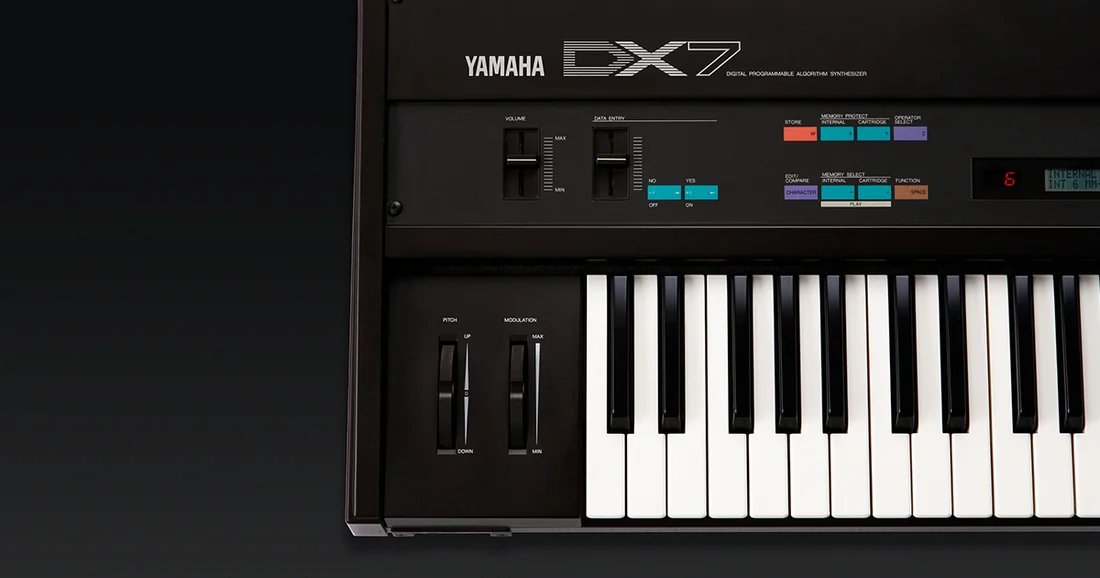
Yamaha's own Design Insights page for the DX7 states that in 1983, during the height of analog synthesizers and the technopop movement, Yamaha announced the DX7 as a digital synthesizer built around frequency modulation, or FM, sound generation. The page, credited to designer Yasuhiro Kira of the Yamaha Design Laboratory, describes a deliberate design choice: a square, simple form without the exposed knobs that defined analog synthesizers, and membrane switches, not previously common on instruments, arranged on a flat panel and picked out in a bright green later called DX Green. Yamaha's own product listing for the now-discontinued instrument states it used a 6-operator, 32-algorithm FM sound source with an 8-parameter digital envelope generator, keyboard scaling, key-velocity response, and MIDI connectivity, at a listed retail price of 248,000 yen before tax. Neither page describes the DX7 as using any AI or machine-learning technique; both describe conventional digital signal generation and switch-based control.
Rights status
Rights questions are largely absent from this history because the DX7 was sold as hardware, not licensed as data or a subscription service. What Yamaha's own materials establish is a design and engineering record, not a licensing precedent: the instrument's sound-design lineage is well documented, but nothing in these pages speaks to how a modern plugin that models or resynthesizes an FM sound informed by the DX7 should be licensed today.
What to check before you use it
This is an editorial checklist. Before treating a modern tool's FM-inspired or DX-style feature as historically equivalent to the original, check whether the vendor's own materials describe a licensed modeling relationship with Yamaha or only a stylistic homage. Confirm whether a plugin's EULA addresses commercial use of DX7-style presets separately from the plugin itself. And verify a vendor's marketing claim about authentic FM synthesis against Yamaha's own technical description, since the two are not automatically the same.
- Does the vendor claim a licensed relationship to the original DX7 architecture, or only a stylistic reference?
- What does the plugin's own EULA say about commercial use of factory or DX-style presets?
- Is an authentic-FM marketing claim verifiable against Yamaha's own technical description?
The DX7's real legacy, on Yamaha's own account, is a design argument as much as a sonic one: that a digital instrument should look and operate unmistakably differently from the analog gear it was replacing. Later tools that borrow its sound owe that argument nothing in the way of automatic rights.
Sources & reading trail
Yamaha's own design page states that in 1983, amid the analog synthesizer boom and technopop movement, Yamaha announced the DX7 FM digital synthesizer, designed by Yasuhiro Kira with a square minimalist form and membrane switches, its color later called DX Green.
Source published: Not established · Retrieved: 16 September 2026
Yamaha's own discontinued-product listing states the DX7 used a 6-operator, 32-algorithm FM sound source with an 8-parameter envelope generator, keyboard scaling, key velocity, MIDI terminals, and a listed retail price of 248,000 yen before tax.
Source published: Not established · Retrieved: 16 September 2026
Documentation, licences and platform policies establish the note; the what-to-check reading is Music Tech Field Notes editorial analysis. This retrospective draft does not imply the site published on the event date.